
Research Highlights
Selected publications by topic
Mechanochemistry
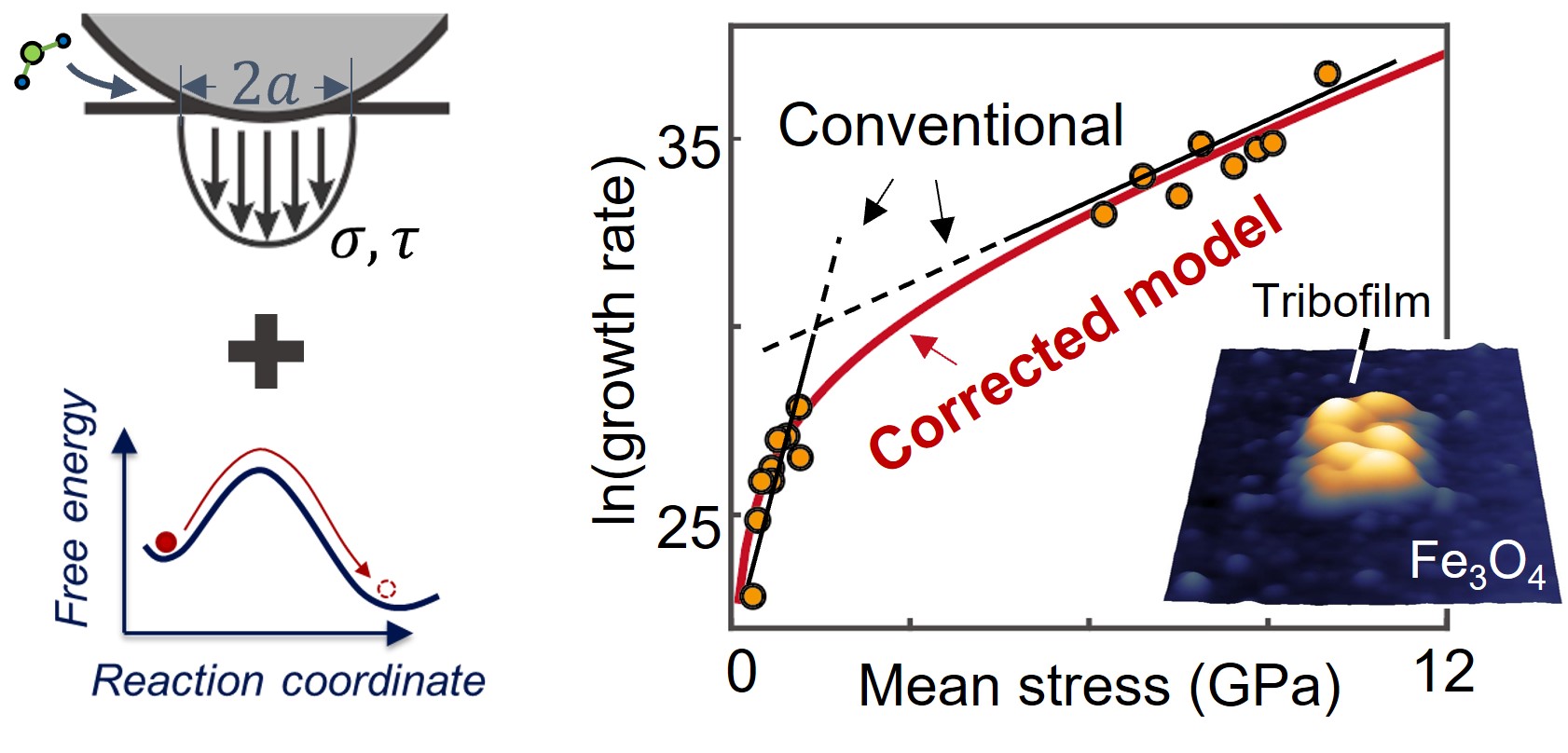
Mechanochemistry involves controlling chemical reactions through mechanical stress. Tribochemistry – a subset of mechanochemistry happening at contact interfaces – plays crucial roles in engineering systems like automobile engines. This emerging field presents new challenges in understanding the coupled mechanical and chemical processes …
Cangyu Qu, Lu Fang, Robert W. Carpick*. Contact Mechanics Correction of Activation Volumes in Mechanochemistry. Phys. Rev. B 111, 195405 (2025) | paper link | Penn Engineering Research Highlight
Summary
When surfaces rub together, they can trigger chemical reactions—an effect termed mechanochemistry and critical to engineering mechanical interfaces and emerging sustainable chemical synthesis. But quantitatively measuring how stress drives these reactions has been surprisingly inconsistent. Our research reveals that hidden mechanical factors can distort these measurements, leading to large errors. We developed a correction model to resolve this, helping scientists better understand and control these force-driven reactions.
Nanomechanics & 2D materials
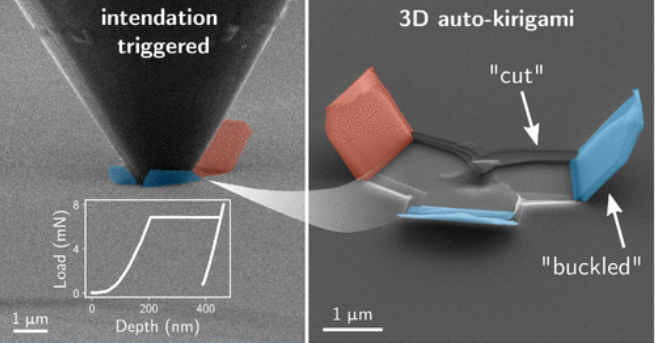
Two-dimensonal (2D) materials with single- to few-atoms thickness exhibit unique properties different from their bulk counterparts. Understanding their mechanical behaviors including strength, flexibility, and failure is key to a variety of relevant applications. However, due to the tiny length sclaes involved, it often requires advanced tools and clever experimental design …
Luc N. Capaldi, Li Yuan, Cangyu Qu, Daniel A. Sánchez, Robert W. Carpick*, Ottman A. Tertuliano*. High-Throughput Formation of 3D van der Waals Auto-Kirigami. Nano Lett. 25(11), 3964 (2025) | paper link | Penn Engineering Research Highlight
Summary
This study introduces a novel, high-throughput method to create three-dimensional structures from two-dimensional materials like graphene. By leveraging a process called "auto-kirigami," we create fold and fracture of 2D materials into intricate 3D shapes without manual intervention. This advancement opens new avenues for designing flexible and responsive nanoscale devices.
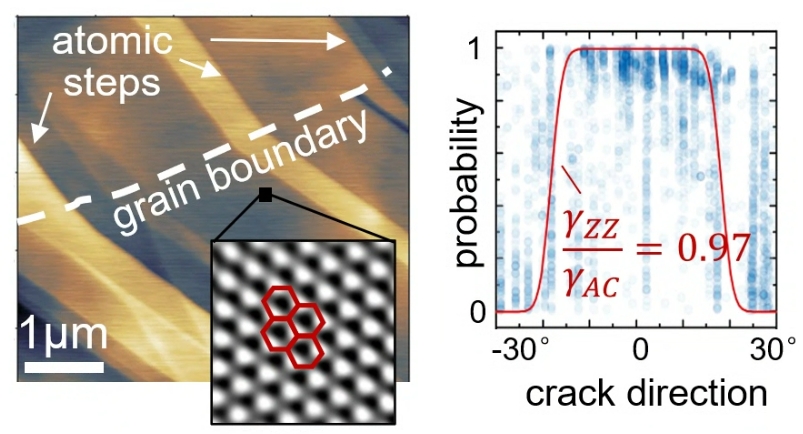
Cangyu Qu*, Diwei Shi, Li Chen, Zhanghui Wu, Jin Wang, Songlin Shi, Enlai Gao, Zhiping Xu, Quanshui Zheng*. Anisotropic Fracture of Graphene Revealed by Surface Steps on Graphite. Phys. Rev. Lett 129, 026101 (2022) | paper link
Summary
Graphene, a one-atom-thick sheet of carbon atoms, is renowned for its exceptional strength. But its resistance to fracture isn't uniform in all directions. By examining the atomic-scale surface features left behind after fracture, we show that graphene cracks more easily along certain orientations. This directional dependence, known as anisotropic fracture, is crucial for the functioning of graphene-based devices and relevant to a unique toughening mechanism in 2D materials.
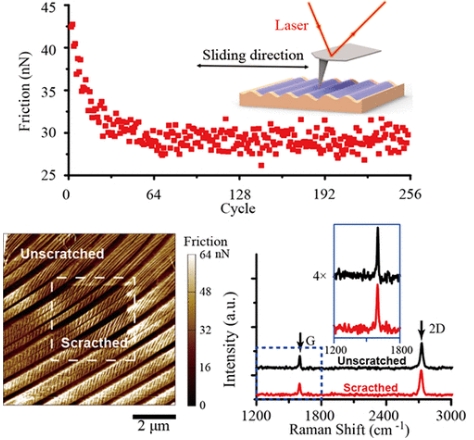
Shuji Zhao, Songlin Shi, Kailun Xia, Tao Wang, Maosheng Chai, Yingying Zhang, Cangyu Qu*, Quanshui Zheng*. Scratching of Graphene-Coated Cu Substrates Leads to Hardened Cu Interfaces with Enhanced Lubricity. ACS Appl. Nano Mater 3(2), 1992 (2020) | paper link
Summary
Frictional contacts often experience a "running-in" period, where friction decreases due to changes in surface geometry (like roughness) associated with wear. Here, we show that graphene-coated copper also exhibits running-in behavior—but without damaging the graphene. Instead, the friction drop comes from hardening of the copper beneath the coating. This study showcases the excellent anti-wear performance of graphene as a mechanically robust, atomically-thin coating.
Superlubricity
Friction and wear cause significant energy losses and equipment failures across scales. Structural superlubricity – near-frictionless sliding without the use of any lubricants – arises from the atomic-scale structures of contacting surfaces. This unique phenomenon offers potentially revolutionary strategy for solving friction and wear problems, particularly on nano- and microscales …
Novel phenomena in superlubricity
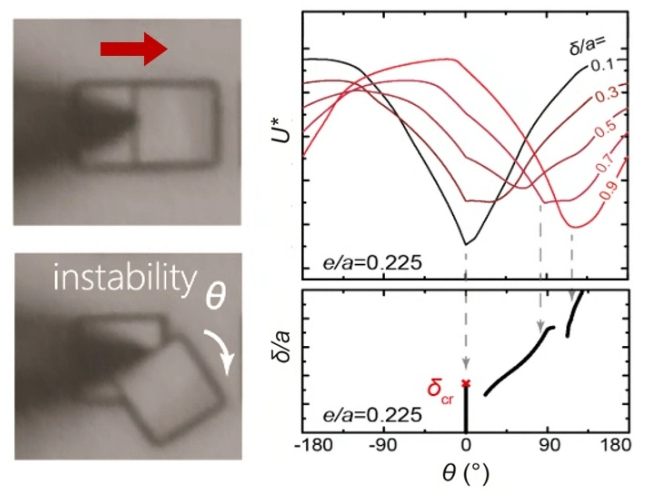
Cangyu Qu, Songlin Shi, Ming Ma, Quanshui Zheng*. Rotational Instability in Superlubric Joints. Phys. Rev. Lett. 122(24), 246101 (2019)| paper link | Highlighted by Nature Materials
Summary
Instabilities driven by surface energy are common in liquids but rare in solids. However, we uncovers such an instability in superlubric 2D materials: a sliding graphite flake suddenly transitions from translation into rotating motion driven by surface energy minimization. The effect highlights how surface energy can govern superlubric systems, offering insights for controlling motion in nanoscale devices.
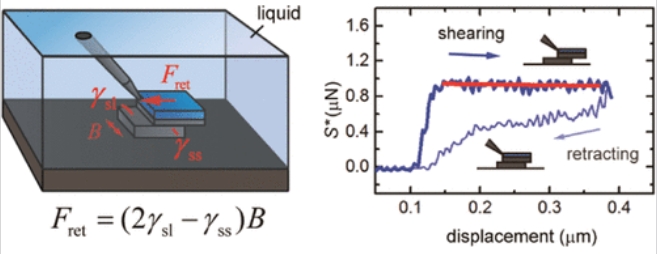
Cangyu Qu, Wei Cao, Bingtong Liu, Anle Wang, Fankai Xie, Ming Ma, Wenzhe Shan, Michael Urbakh, Quanshui Zheng*. Direct Measurement of Adhesions of Liquids on Graphite. J. Phys. Chem. C, 123(18), 11671 (2019)| paper link
Summary
Graphite and other 2D materials interact with liquids in ways crucial for sensors, coatings, and energy devices, but their adhesion is hard to measure. This study introduces a new method, directly enabled by the near-frictionless nature of superlubricity, to measure how strongly liquids adhere to graphite using tiny self-retracting graphite flakes. The approach offers a novel and reliable way to study liquid–2D material interactions.
Fundamental mechanisms of superlubricity
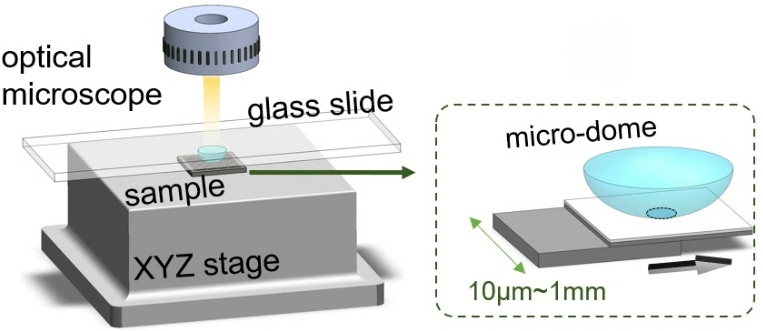
Dinglin Yang, Cangyu Qu*, Yujie Gongyang, Quanshui Zheng*. Manipulation and Characterization of Submillimeter Shearing Contacts in Graphite by the Micro-Dome Technique. ACS Appl. Mater. Interfaces 15(37), 44563 (2023) | paper link
Summary
This study introduces a "micro-dome" technique to slide and study submillimeter-scale graphite contacts for exploring superlubricity—a state of near-zero friction. The method enables access to much larger (x2500) interfaces than previously possible and reveals structural features that limit frictionless motion, offering insights and experimental tools for scaling superlubricity up in layered materials.
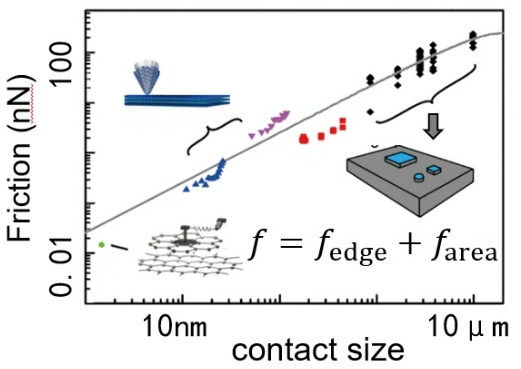
Cangyu Qu, Kunqi Wang, Jin Wang, Yujie Gongyang, Robert W. Carpick, Michael Urbakh, Quanshui Zheng*. Origin of Friction in Superlubric Graphite Contacts. Phys. Rev. Lett. 125(12), 126102 (2020) | paper link
Summary
Classical theories of superlubricity consider ideal, infinitely-large contacts. Here, fore real superlubric contacts, we decoupled the friction contributions from the contact area and the contact edges. We found that the tiny residual friction in superlubricity originates from the edges: each edge atom contributes >10,000 times more friction than an atom inside the contact. These results, along with a derived scaling law, provide clear guidance for designing large-scale, ultra-low-friction interfaces.
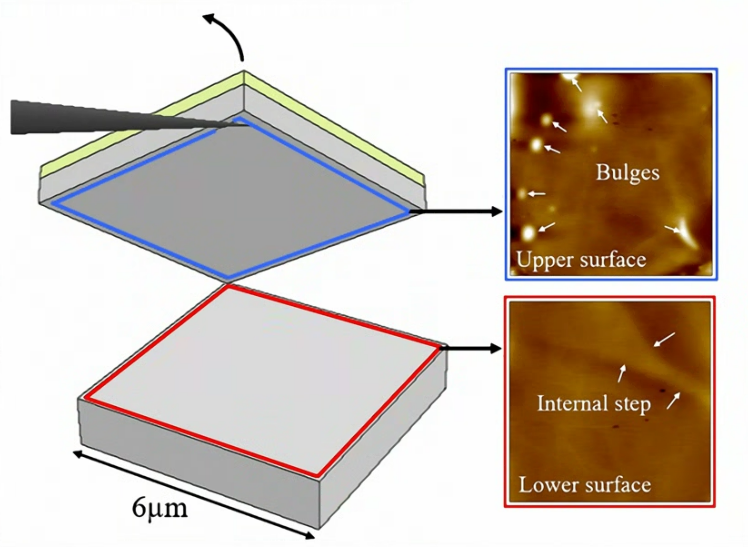
Kunqi Wang, Cangyu Qu*, Jin Wang, Baogang Quan, Quanshui Zheng*. Origin of Friction in Superlubric Graphite Contacts. Phys. Rev. Lett. 125(2), 026101 (2020). (Editors’ Suggestion)| paper link
Summary
Directly characterizing both surfaces of a solid-solid contact is essential but challenging at the nano- and microscale. Using a new "pick-and-flip" technique, we reveal the hidden interfaces in superlubric contacts. We confirm that superlubricity arises from two misaligned crystalline surfaces and show that its failure is caused by external defects—explaining why only some contacts exhibit superlubricity and guiding the design of ultra-low-friction systems.
Complete Publication List
Complete publication list can be found in my CV or my Google Scholar profile.